
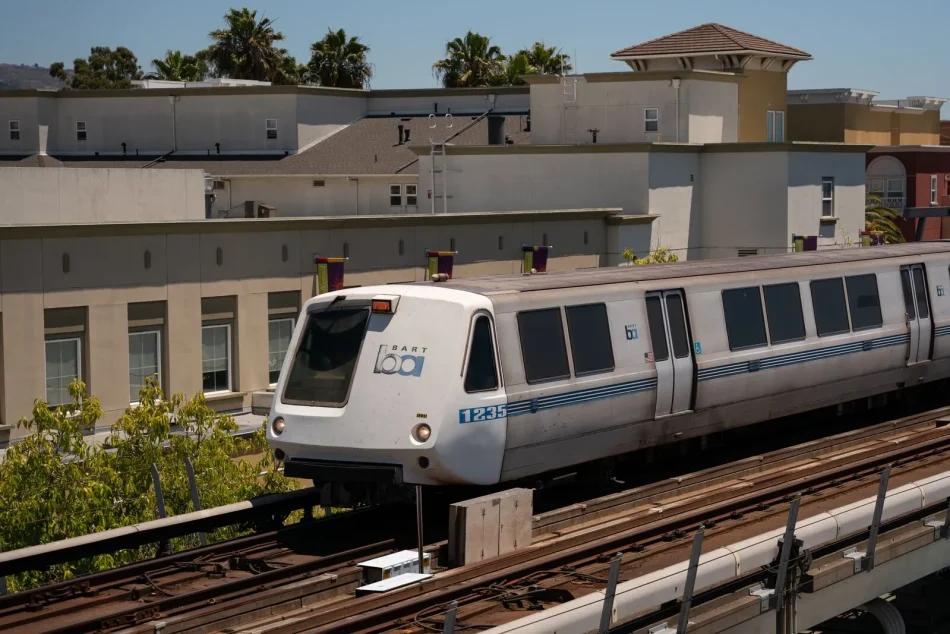
BART has said it would have to close stations and eliminate weekend service.
AC Transit has said whole lines would be cut.
In the face of anemic ridership and rising costs, the Bay Area transit agencies have one shared bailout plan: a sales tax measure on the ballot this November.
This week, the Metropolitan Transportation Commission announced that the tax measure, formally known as Connect Bay Area, had qualified for the November 2026 ballot, after election officials validated more than 300,000 signatures from Alameda, Contra Costa, San Francisco, San Mateo, and Santa Clara counties. That was well over the required number of signatures — by around 66%.
“The overwhelming signature total that led to the measure’s qualification for the ballot reflects broad public support for transit and growing awareness of the urgency surrounding the future of Bay Area public transportation,” the agency said in a press release.
The measure proposes an additional 0.5% sales tax in Alameda, Contra Costa, San Mateo, and Santa Clara counties and an additional 1% sales tax in San Francisco, to raise an estimated $14 billion for mass transit over 14 years.
But some people paying attention to the measure have expressed concern about whether the wholesale rejection of Bay Area tax measures on the primary ballot in June suggests voters may turn against the measure.
Voters in counties that need to pass this measure for it to go into effect rejected tax initiatives at the ballot box in June, sending a message that they were tired of paying more taxes for the same basic services. In Oakland, Measure E, a parcel tax, crashed out. In Contra Costa County, a sales tax measure designed to help low-income healthcare programs failed. San Francisco’s Overpaid CEO tax failed. Even a tax measure in El Cerrito to build new libraries failed.
Yet when we spoke with advocates leading the ballot initiative this November, none of them seemed especially worried. They told The Oaklandside that they are seeing momentum toward securing a simple majority and giving the transit agencies a much-needed boost.
No ‘concerted, funded opposition’
Carter Lavin, of the Transbay Coalition, a group of transit advocates, pointed out that the only tax measure involving transit on the June ballot, the SMART sales tax in Marin County, sailed through with 70% of the vote. And he noted that at least one of the tax measures that failed, Measure G in Contra Costa County, failed despite exceeding the 50%-plus-one threshold required for the Connect Bay Area transit measure to pass. (Measure G required 55% to pass.)
He said it’s easy for voters to understand how the collapse of transit could affect everyone by increasing traffic and pollution, and making parking and access to jobs more of a challenge. Lavin said that’s why the transit measure hasn’t faced the kind of organized opposition that Measure E in Oakland or the San Francisco CEO tax faced.
“ We’re feeling that people are still looking to invest in their communities, and I think a really key element is that we see the difference in elections where there was concerted, funded opposition versus ones where there weren’t,” Lavin said. “The regional measure is supported by labor, by businesses, by progressives, by immigrant rights groups, health and housing groups.”
Still, Lavin said the absence of opposition doesn’t mean the measure will be a cakewalk.
He told us the groups he’s working with in the region have amassed a volunteer army of more than 1,000 people who are knocking on doors, making social videos, and talking to people at major events this month, including at World Cup soccer watch parties at San Pedro Square in San Jose.
“We’re helping people do the math where they realize what the tax gets them,” he said. “For the vast majority of people in the Bay Area, the sales tax amounts will more than pay for themselves.”
Abibat Rahman-Davies, the transportation policy manager at TransForm CA, an Oakland mass transit advocacy group, said those leading the campaign are aware that people are worried about costs more than ever, given that the economy is not in the best shape. That’s why the coalition TransForm, of which Voices for Public Transportation is part, has focused on explaining the measure’s benefits in detail to influential groups, such as unions like SEIU 1021.
“We inform nonprofits and advocacy groups about what the measure is about, get them to endorse the measure, then they take that back to their communities and speak to the people they serve to get them to support the measure and vote yes in November,“ he said.
Many of the groups they’ve made presentations to, Rahman-Davies said, had been unaware of the financial straits the transit agencies were in. He said that communicating the gravity of the problem will be the focus over the next two months, now that the signatures have been verified and the measure is on the ballot.
Rahman-Davies said he was confident the measure would pass because the November general election typically brings out more voters.
Accounting measures could win over skeptics
We reached out to Ethan Elkind, an attorney who directs a climate program at UC Berkeley Law School and has written about transit policy, including the history of the Los Angeles Metro rail system. He told The Oaklandside that cost-of-living worries combined with concerns about operational problems and inefficient management of funds at transit agencies are significant enough issues in the current voting climate that, if the measure needed a two-thirds majority, it would likely fail.
Some people will always vote against government spending, he said, and then “there’s sort of a centrist group of voters who feel that if the agencies are being wasteful,” who may vote against it, too, he said. That’s why Gov. Gavin Newsom and state legislators have added cost accounting, like an oversight committee and county control, as a requirement for this measure, as they did for previous emergency transit funds. “That could be a difference between 49% and 51%” of the vote,” Elkind said.
Another wild card for the November election, Elkind said, is that people do not use transit as much as they did before the pandemic, leaving some feeling less connected to it. Though he pointed out that it’s possible the same number of individuals are still using it, just less often, due to work-from-home initiatives, including many people in Oakland who ride BART.
Still, Elkind said that the ballot initiatives for transit funds have generally been successful. “BART is very central to the Bay Area economy and transit in general,” he said.